

Indonesia
Research by Bennett Jarvis, Nathan Le, and Matthew Schwarzenbach. Writing and editing by Bennett Jarvis, Amanda Gill, and Sofie Richardson.
Overview
With the launch of its new Indonesia Forestry Carbon Hub in July 2026, Indonesia saw the first ministerial approvals to proceed with forest carbon credit issuance since the government effectively ended cross-border trading with 2021 rules. [20] [50] Only a few days later, the government launched its new registry, the National Carbon Unit Registry (SRUK), intended to enhance traceability and monitoring, reporting, and verification. [50]
Following the lifting of the moratorium in 2025, Indonesia has taken great interest in generating revenue from carbon trading. The country plans to generate billions of dollars in revenue through bilateral deals associated with Article 6.2. If the country’s claims to 13.4 billion metric tons of carbon dioxide equivalent in potential carbon credits are accurate, Indonesia could be among the biggest carbon offset suppliers in the world. [22] Beginning in 2021, Indonesia implemented its Carbon Economic Value, or Nilai Ekonomi Karbon (NEK) through Presidential Regulation No. 98 of 2021, which established a framework for carbon trading and emission reduction, initially focusing on the power and forestry sectors. Alongside 98/2021, the MOEF 21/2022 was the other pillar of carbon market legislation in Indonesia, setting out the provisions of a Carbon Trading Roadmap in Indonesia, as well as detailing mechanisms for domestic and international carbon trading, buffer obligations, voluntary carbon markets, and mutual recognition. In 2025, Presidential Regulation 110/2025 replaced 98/2021 as the primary regulation governing NEK; this was followed up by Ministry of Forestry Regulation 6/2026 (MoF Reg. 6/2026) that now governs carbon programs in the forestry sector.
The primary purpose of PR 110/2025 was to address major gaps in the previous PR 98/2021, which initially focused on the power and forestry sectors, \and overcome what the government viewed as hurdles to carbon market implementation. [5] The law adds the new national registry, the SRUK, in which every carbon project must be registered (Article 1(20), 58). SRUK does not completely displace the previous National Registry System for Climate Change Control (SRN PPI), but narrows SRN PPI’s scope to the management of data and information on climate change mitigation and adaptation actions and resources at the level of the country’s Nationally Determined Contribution (NDC) (Article 1(19)), while carbon-unit data are managed in SRUK (Article 1(20)). Both systems remain pillars of the national framework for achieving the NDC (Article 75). [43] The purpose of this new system is to enhance transparency surrounding transactions through clearer mandates and a separation of project-level data from information on the country’s NDC in the hope of preventing double counting.
PR 110/2025 also goes beyond the earlier law’s definition of potential mechanisms for achieving NEK (i.e. carbon trading, result-based payments, carbon levies, among other approaches), PR 110/2025 now defines these mechanisms as specific instruments regulated under the NEK framework (Article 55). Carbon trading includes both compliance and offset mechanisms and generally aligns offsetting in the country with its NDC targets by requiring all emissions reductions generated through regulated NEK instruments to contribute to Indonesia’s NDC, unless it is being exported with the required Authorization and Corresponding Adjustment under Article 6 (Article 56). At the same time, the regulation decouples voluntary carbon trading from the NDC timeline, allowing projects to generate and sell credits without waiting for national targets to be met. [40] The integration into the same regulatory framework of both Indonesia’s compliance system and offsetting projects, alongside carbon levies, is part of what makes Indonesia’s carbon markets so complex.
This complexity is not, however, matched with clarity in many cases. Although the regulation outlines how offsetting projects are approved, a process that mirrors or links to international standards’ requirements, it leaves key integrity issues unaddressed and subject instead to different methodologies. One of the earliest laws that apply 110/2025 sectorally, MoF. Reg. 6/2026, does not add much clarity either.
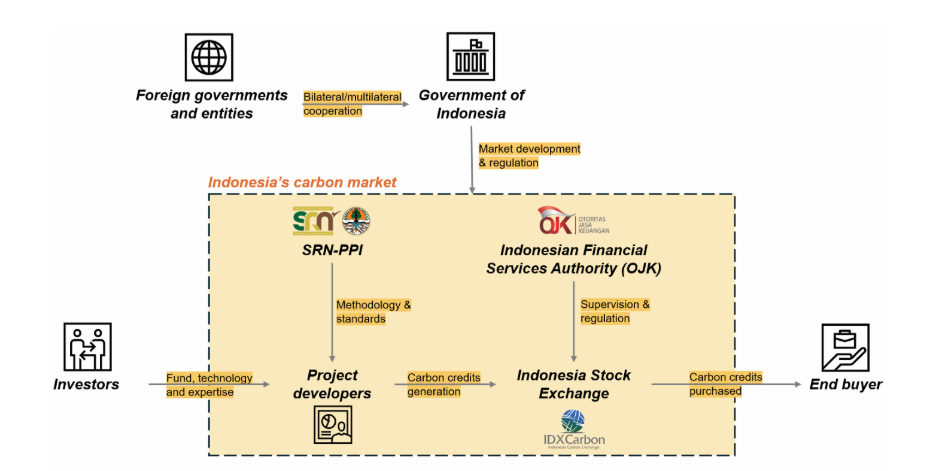
Diagram from PwC paper indicating stakeholders in Indonesian carbon markets. Notice that local communities are not listed here. Source: PWC. “Indonesia Carbon Markets White Paper”, December 2024, pg. 16.
The bottom line is that the Indonesian government, particularly in the early 2020s up to now, has sought to create a comprehensive, multi-sectoral carbon trading system that is linked to international offsetting markets and which helps set carbon prices. At the same time, the carbon trading scheme does not give priority to the rights of Indigenous Peoples and local communities: participation depends on formal state recognition of customary forests, which remains incomplete, and the safeguards that do exist, including FPIC, lack clear implementation guidelines or standards. [9] [11] [30] [44] At a time when carbon trading is becoming ever more prominent in Indonesia, particularly in the forestry sector, this complexity could raise a number of issues that are not immediately apparent.
Legal and Institutional Framework
All forests in Indonesia are under state control (Article 4(1)), however forests may have two distinct statuses: state forests and titled forests, with customary forests included as state forests (Article 5), and will be classified based on three distinct functions: conservation forests, preservation forests, and production forests (Article 6).
Preservation forest utilization can include use of the forest’s area, environmental services, and collection of non-timber products (Article 26). Production forest utilization can include use of the area, environmental services, and timber and non-timber products (Article 28). Utilization of preservation and production forest is regulated through licenses which may be granted to individuals, private companies, and government-owned companies.
Sets the legal basis for the 5 community forest specifications: community forests, village forests, community plantation forests, forestry partnerships, and customary forests. Under Law No. 41 of 1999, customary communities retain the right to manage and use forest under their customary laws given they are formally recognized by the state. In the case a community is not formally recognized or registered, the land defaults to state regulation. Under Article 68, communities are entitled to compensation from either damage or loss of access to their forest.
Law No. 32 of 2009 was enacted to address global warming, climate change, and domestic environmental degradation. The law requires the Indonesian government to regulate “high impact” activities and businesses. In Article 88, Law No. 32 uses the legal principle of Strict Liability which makes actors completely responsible for damages or injury caused by their actions regardless of intent or fault. Article 42 to 44 of Law No. 32 introduces the possible use of Economic Instruments and incentives like planning, funding and tradable waste permits. It also mandates the Indonesian government to provide environmental funding to regional governments that demonstrate strong environmental protection
Government Regulation No. 46 of 2017 introduces economic incentives rather than solely regulation. The three categories of instruments the law establishes are (1) development planning, (2) environmental funding and, (3) incentives and disincentives. Articles 4 and 5 require the national and regional governments to incorporate economic incentives in development planning and public finance that would encourage environmentally responsible behavior. The Law also introduces an environmentally adjusted Gross Domestic Product and Regional Gross Domestic Product which is used to measure economic output accounting for depletion of natural resources and requires environmental costs to be incorporated into economic activities. Government Regulation No. 46 of 2017 Chapter IV Article 31 requires the national and regional governments to create and monitor an emissions trading system.
Presidential Regulation No. 77/2018 created an Indonesian institution that manages money flowing into environmental projects. Under Articles 3-6, the Indonesian Environment Fund is authorized to collect funds from governments, international donors, grants and private entities. Under Article 2, the fund can distribute funds that support environmental protection with loans, subsidies and grants. The Indonesian Environment Fund handles only a portion of the government funding towards Carbon projects. The IEF is designated to manage the majority of the REDD+ payments and International funding from other countries. Presidential Regulation No. 77/2018 created the IEF which now supports carbon market activities under Presidential Regulation No. 98 of 2021.
Law No. 7 of 2021 builds on Law No. 32 of 2009 by introducing a new economic instrument to control carbon emissions. The majority of Law No. 7 of 2021 is standard Tax Law which defines tax brackets for different types of entities and earning levels. Chapter VI introduces a carbon tax which corporations have to pay on emissions over their permitted level. Prior to this, the mandated economic instruments Indonesia used were environmental funding and emissions permit trading. Law No. 7 of 2021 assigns a direct cost to corporations encouraging businesses to reduce emissions whenever doing so is less expensive than paying the tax. With the additional economics instrument corporations that over pollute can either purchase emissions permits from under-emitting companies or pay taxes on the emissions over produced.
PP No. 18/2021 was created to clearly define land management, use and registration of state owned land. In Chapter VI, the regulation requires clear registration of land and land transfers with the use of electronic registration. Chapter VI works to reduce ownership disputes and clarify rights of the lessor or owner. Chapter IV regulates the right to build, cultivate, and use land. The rights have time and entity restrictions, most are limited to 30 years and Indonesian citizens. To maintain the rights holders of the rights are also obligated to preserve the natural resources and environment of the land. Chapter III regulates the right to manage state owned land. The right to manage is the right to use or restrict the use or development of land on another party for a specific purpose. The right to manage also gives the holder, almost always a government entity or government owned entity, the power to split the land in parts including subsurface, surface and air. This law is fundamental for today's carbon market as it allows underground carbon capture and some permanence in conservation of a land for the agreed years of use. The law sets fundamental limits for the use of state-owned land. In Article 1, PP No. 18/2021 defines what state lands are. State land is considered any land that is not private, religious or communal land belonging to indigenous or traditional communities. A problem stems from indigenous communities not having been formally recognized or having registered land.
Presidential Regulation No. 98 of 2021 is the regulation that allowed for carbon trading to exist and introduced carbon credits. This law was made to build the framework for how Indonesia was going to achieve their climate targets. Article 1 defines Carbon Rights as controlled by the state, and Article 3 sets an unconditional Greenhouse Gas emission reductions as 29% and 41% conditioned on international support. Articles 7 and 15 assign government ministries to handle Greenhouse Gas accounting and regulation for each Nationally Determined Contribution sector. Chapter IV which covers Indonesia's carbon pricing framework, Article 47 regulates carbon trading, results based payments, carbon taxes and other economic instruments to reduce Greenhouse Gas emission. Under Article 69, all businesses are required to register and report their carbon emissions and mitigation actions through a national registry. As businesses have Greenhouse Gas emissions caps, Article 48-49 allow carbon trading through Emissions Trading for entities with an emissions cap and GHG emissions offsets for entities without an emissions cap or projects that reduce emissions beyond or below a baseline. Presidential Regulation No. 98 of 2021 established Indonesia’s carbon market by creating a legal framework for carbon trading, emissions accounting and carbon pricing.
This was replaced by Presidential Regulation No. 110 of 2025 on the Implementation of Carbon Economic Value Instruments and National Greenhouse Gas Emission Control (“PR 110/2025”). [31]
Building off of Presidential Regulation No. 98 of 2021, the Ministry of Energy and Mineral Resources set specific emission limits for coal fired power plants. Prior to this law power plants were only able to trade emissions given their caps and usages. Under MEMR Regulation No. 16 of 2022, power plants are now able to offset their excess emissions. Coal plants are first required to offset excess emissions using renewable energy plants to avoid emissions. Coal plants are then able to offset cross sector emissions such as forestry preservation or carbon capture. This regulation was created to prevent cheap offsets and encourage real transition to renewable energy. MEMR Regulation No. 16 of 2022 correctly puts pressure on the energy sector rather than allowing coal plants to export the cost on another sector.
MOEF Regulation 21 of 2022 covers the general provisions for implementing PR 98 of 2021 in the environment and forestry sector, including requiring that projects be recorded in the SRN-PPI registry, use approved methodologies, follow national MRV rules, and undergo validation and verification. The law also covers the implementation of GHG emissions caps for business actors – which allows for offsetting (Article 13) – and international offset trading for businesses without emissions caps which requires the development of a project design document (DRAM) (Article 15).
Regulation 21/2022 on Guidelines for Implementing the Carbon Economic Value remains in effect insofar as they do not contradict the new regulation.
Required by Article 3 of Presidential Regulation No. 98 of 2021, MOEF Decree 168/2022 sets a plan for the forestry and land-use sector to absorb more carbon than it emits by 2030. The plan sets out three land categories which are forest, peatlands and coastal with seven assigned mitigation actions, ranging from reducing forest degradation, rotational rehabilitation and biodiversity conservation. The plan assigns specific responsibilities to specific concessions and land-use license holders. Companies holding forest use licenses under Forestry Law 41 of 1999 are required to comply with the plan’s mitigation targets. Companies holding the right to cultivate licenses under Government Regulation Number 18 of 2021 are required to comply with the plans narrower obligations like water management. While taking actions required by the plan, companies are allowed to participate in carbon trading.
MoEF Decree SK.1027 establishes what counts as a carbon credit produced from Indonesia’s forestry sector. Credits must be produced by one of six mitigation activities: reducing deforestation, reducing forest degradation, forest development, forest management, increasing carbon stocks, and improving peatland water management. Baseline emissions are calculated to produce avoided emissions credits. For trading credits internationally, credits used for a country's NDC have to be authorized and adjusted under the Paris agreement. An authorization requires a country exporting a credit to give permission to the importing country to use the credit towards their NDC. An adjustment is to correct the carbon accounting to prevent double counting of a carbon credit produced. MoEF Decree SK.1027 allows for credits to be sold internationally without an authorization or adjustment. The nonauthorized and nonadjusted forestry credits are used in the voluntary market. Authorized and non adjusted can potentially be counted for two separate countries NDC’s. The legal opening for nonadjusted and nonauthorized forestry credits to be sold internationally allows for a market of carbon credits unrelated to the United Nations Paris Agreement. This incentivises major private companies to fund projects, claim net zero emissions and avoid additional cost or oversight. While this can lead to double counting and lack of verifications, from a policy standpoint, the additional investments from large corporations into conservation outweighs the drawbacks.
Law No. 4/2023 defines carbon credits as a legal financial security regulating carbon as a financial transaction. This law gives the Indonesian Financial Services Authority the power to regulate the flow of carbon credits domestically and internationally. However, the Ministry of the Environment and Forestry are still responsible for measuring, verifying and carbon reduction. The law also legalizes an exchange for carbon credits which is now the Indonesian Carbon Exchange.
These regulations primarily concern procedures for carbon trading in the forestry sector, in line with PR 98 of 2021 and Indonesia’s FOLU Net Sink 2030 Plan. The law stipulates that forestry mitigation activities can be carried out via carbon trading based on storing or absorbing forest carbon, with 22 specific mitigation activities outlined in the law itself (Article 3(1-3)). Following on PR 98 or 2021 and MOEF Regulation 21 of 2022, the law recognizes both domestic emissions trading (i.e. companies that have an emissions cap and can trade allowances amongst themselves) and emissions offsetting (companies that do not have an emissions cap, which establish an emissions baseline, and which participate in international trading). However, only projects in peat and mangrove areas are eligible for emissions trading whereas emissions offsetting can occur in other forest areas regulated in MoEF Reg7/2023, including permanent production forest areas, convertible production forest areas, protected forest areas, peat and mangrove areas, conservation forest areas, customary forests, rights forests, and state forests that are not forest areas (Article 6; Article 7(4-5)).
Holders of a Forest Utilization Business License, management permit holders, and forest owners must have a sustainable forest management certificate, a forest product legality certificate, or a forest product declaration. Indigenous Peoples and holders of social forestry management agreements must receive assistance from third parties with expertise in carbon measurement and carbon market access (Articles 7 and 8).
This law was replaced by MoF No. 6 of 2026.
OJK Regulation 14/2023 creates the framework to trade carbon as a financial security allowed by Law No. 4/2023. This regulation by the Financial Services Authority of Indonesia requires every carbon credit to be registered with the Ministry of Environment and Forestry and a licensed carbon exchange administrator, currently the Indonesian Stock Exchange. The law also allows for foreign carbon credits to enter Indonesia’s carbon market as long as they are registered and verified with an accredited international registry. The Indonesian carbon exchange launched in September 2023.
This amendment was promulgated on July 6, 2026. Its creation was necessary to amend the provisions in Financial Services Authority Regulation Number 14 of 2023 concerning Carbon Trading through the Carbon Exchange to align with Presidential Regulation Number 110 of 2025 concerning Implementation of Carbon Economic Value Instruments and Controlling National Greenhouse Gas Emissions.
This POJK regulates provisions that amend several provisions in POJK 14/2023, including: 1) Carbon Units traded on the Carbon Exchange must be registered in the Carbon Unit Registry System (SRUK) which replaces the National Climate Change Control Registry System (SRN PPI); 2) Trading of carbon units from abroad that are not registered in the SRUK; 3) Expansion of the scope of Carbon Units; 4) Determination of the submission of certain reports by Carbon Exchange Organizers to the relevant Ministry; 5) Provisions regarding relevant consumer protection principles as regulated in the POJK regarding consumer and community protection in the financial services sector apply to every Party involved in Carbon Trading through the Carbon Exchange; and 6) Facilitation of trading of Carbon Units recorded in the electronic-based system at the relevant ministry can be carried out until the SRUK is operational, no later than 3 (three) months after this Financial Services Authority Regulation is enacted.
Identifies carbon trading (both compliance and offsets), result-based payments, carbon levies, and other evolving approaches as “NEK instruments” governed under the NEK framework (Article 55).
Distributes substantial authority to sectoral ministries to oversee the application of offsetting regulations in their sector and then recommend the issuance of carbon units to the Minister of Environment.
In order to obtain carbon units from an offsetting project, businesses must (Article 65):
- Submit a Mitigation Action Design Document (DRAM, for application of national standards) or a Project Design Document (DPP, for international standards).
- Have the DRAM or DPP validated by an independent validator.
- Implement the climate change mitigation action in accordance with the validated DRAM or DPP.
- Have the achievement of the Climate change mitigation action verified by an independent verifier.
- Submit the verification report on the achievement of the climate change mitigation action to the relevant minister.
Previous requirements for a Mutual Recognition Agreement with international standards in order to trade carbon internationally have been removed (Article 68(3)).
While the previous law is fully replaced, implementing regulations under it remain in force except provisions contradicted by 110/2025. The government has one year to develop new sectoral implementing regulations and businesses have one year to fully comply with the new law.
MoF 6/2026 replaces MOEF Regulation No. 7 of 2023 and translates PR 110/2025 into implementation regulations for the forestry sector.
The law restricts entities that can participate in forest carbon trading to (Article 6(1)):
- Holders of a Forest Utilization Business License (PBPH)
- Holders of social forestry approvals.
- Customary law communities with recognized forest status.
- Holders of private forest rights.
- Holders of Carbon Environmental Services Utilization Business License (PB-PJL Karbon).
The law establishes eligible areas for forest carbon projects (Article 9):
- Production forests already subject to necessary licenses and management rights.
- Utilization zones of Nature Conservation Area and game reserves where management rights do not already exist.
- Customary forests.
- Private forests.
- State land outside designated forest areas.
Responsibility and liability lies with permit holders (specifically holders of PBPH or PB-PJL Karbon) even when third party investors or proponents are involved (Article 8). On the other hand, when communities are involved through social forestry, customary forests, or private rights, third party partners must be involved who will be subject to these requirements (Article 6(2)).
As stipulated by 110/2025, all project developers must submit a DRAM or DPP and be recorded in the SRUK system (Article 11).
Integrated into DRAM requirements are social safeguards, including (Article 12(2)):
- Identification of a project propone
- Demonstration of additionality.
- Community engagement plan.
- Benefit-sharing agreement.
- Identification of biodiversity impacts and reversal risks plus a management plan for them.
- “Plans and achievements” for FPIC.
The law further stipulates that the protection of the rights of Indigenous Peoples and local communities, as well as meaningful stakeholder participation throughout the implementation and operation stages are also necessary (Article 28).
Projects must receive a recommendation from the Minister of Forestry to receive carbon units, following the process outlined in Article 65 of 110/2025 (Article 15); the MoF must also conduct a screening of a developer’s previous compliance history (Article 16).
The new framework will continue using the roadmap under SK.1027/MENLHK/PHL/KUM.1/9/2023 until a new one is adopted; this must happen within a year after the passage of this law (Article 63).
This regulation focuses on the procedures for organizing carbon trading through the carbon exchange
As an implementing regulation, this OJK PADK substantially regulates provisions regarding: (1) Carbon Units Traded on Carbon Exchange Organizers; (2) Capitalization of Carbon Exchange Organizers; (3) Shareholder Requirements; (4) Members of the Board of Directors and Members of the Board of Commissioners of Carbon Exchange Organizers; (5) Fit and Proper Assessment of Shareholders, Members of the Board of Directors, and Members of the Board of Commissioners of Carbon Exchange Organizers; (6) Operations and Internal Control; (7) Procedures for Applying for Licensing of Carbon Exchange Organizers; (8) Regulations and Articles of Association of Carbon Exchange Organizers; (9) Annual Work Plan and Budget of Carbon Exchange Organizers; and (10) Reports of Carbon Exchange Organizers.
When this Regulation of the Members of the Board of Commissioners of the Financial Services Authority comes into effect, the Circular Letter of the Financial Services Authority Number 12/SEOJK.04/2023 concerning Procedures for Organizing Carbon Trading through the Carbon Exchange is revoked and declared invalid.
Despite its complexity, Indonesia’s carbon framework leaves open many questions about additionality, permanence, carbon rights, and benefit sharing. These problems sit atop existing land rights conflicts. Although the framework ostensibly provides for community engagement and participation, practice points to broad community exclusion and developers’ manipulation of the permitting regime.
Additionality, Permanence, Carbon Rights: a general lack of clarity
When it comes to common ‘integrity’ issues in carbon projects like additionality or permanence, the legal framework is quite vague. Indonesia’s laws do not define additionality, meaning that additionality continues to be assessed based on methodologies, either those incorporated into the DRAM or those of internationally recognized standards. International benchmarks do exist: the ICVCM’s Core Carbon Principles are ten science-based principles intended to set a global threshold for high-quality carbon credits, and the MoF’s partnership with the ICVCM may eventually supply some of the content that national law currently lacks. [54] The recent MoF 6/2026 requires a demonstration of additionality for forest carbon projects but again, what the requirements of additionality are remain undefined (Article 12(2)).
Permanence is also not defined operationally. While MoEF 21/2022 specifies that offsets under domestic standards (SPE-GRK) must be “real, permanent, measurable, monitored, and reported,” what permanent actually means in practice is unclear and there are no rules for managing reversals or long-term monitoring (Article 60(1)(a)). This also means that the methodology used will determine any permanence standards.
Another key concept that lacks clarity are carbon rights. Nominally, the state holds rights to carbon in Indonesia, even though Indigenous Peoples and local communities’ rights to customary territories or Community-based Area Management have been recognized, including through Constitutional Court Decision No. 35/PUU-X/2012, which held that customary forests are not state forests. [25] Despite the apparent connection between various forms of utilization rights permits and the ability to claim carbon benefits, there is no clear connection made between land tenure and carbon rights or the right to claim carbon benefits. [10] The state can transfer carbon rights so long as the transaction is recorded in the national registry system, and carbon units are legally considered a tradable security. But the legal basis on which carbon rights are founded is not defined. Whether it is considered a natural resource, private property separate from underlying land ownership, or something unique entirely, is not clear. These circumstances are made only worse due to persistent land tenure conflicts. [23]
The specific nature of land governance in Indonesia does potentially point to the separation of carbon rights from land tenure, or at least leaves open this possibility when compared to the legal frameworks governing other kinds of land products. [23] In the context of land tenure conflicts in Indonesia, communities are already at a severe disadvantage, meaning that any suggestion that the separation of land ownership from carbon rights could allow communities to acquire carbon rights without underlying land ownership misses the larger point that community exclusion from carbon projects is largely a symptom of wider land tenure insecurity. [23]
Land conflicts further put the permanence and overall integrity of projects at risk. [38] As such, land tenure conflict is a core issue in Indonesia’s forest carbon markets that recent regulations do not address. Clarifying these integrity concepts would not resolve tenure conflicts, but their absence places Indonesia’s carbon trading system on even shakier footing.
Land Tenure, Project Developers, and Concessions
The majority of land outside of direct control of municipalities, individuals with land deeds, or private companies, is owned directly by the state, under the Ministry of Forestry (MoF). This is about 70% of all land in Indonesia which is classified as “forest zone”. [8] A very small percentage of forest land is privately owned in Indonesia, most is leased under specific permits or licenses. Because forest governance is decentralized and the state has limited capacity to manage forest land and prevent illegal use, the MoF provides limited land-use deeds to villages that serve as protectors and managers of their local forests. These Village forests, or Hutan Desas, are the most common types of preexisting land tenure present in carbon credit project areas. Also present are Community Forests (Hutan Kemasyarakatan), Community Timber Plantations (Hutan Tanaman Rakyat), and Company Community partnership arrangements (Kemitraan). [15]
Village forests are not direct ownership granted to the local communities or government, rather the state is allowing communities to manage their own local forests on the premise that they have the most relevant knowledge. Under these permits, plantation formation and deforestation is still considered illegal and no state assistance is provided to these communities. [59]
Another common land tenure type is the Forest Utilization Rights (PBPH). This has become a mandatory legal instrument for anyone wishing to manage, utilize, or develop a business in forest areas. These rights are given and organizations must determine if the area will be designated protection or production forest areas. [55] PBPHs are held by companies for a long time and are often the basis of REDD projects, typically leveraging the clause that holders are obligated to maintain the ecological, social, and economic functions of the forest. However, local logging companies or those who plan to deforest to create plantations, must own PBPHs. These rights are sometimes transferred to international companies or organizations to create carbon credit projects where carbon credits are provided on the basis of projected deforestation by the previous deed holder.
The Riau Ecosystem Restoration Carbon Project is a case in point. The project has come under increased scrutiny after allegations that its deforestation baseline was inflated. [4] The previous owners of the PBPH licenses were four selective-logging and industrial plantation companies: PT Gemilang Cipta Nusantara, PT The Best One Unitimber, PT Global Alam Nusantara, and PT Sinar Mutiara Nusantara. [3] All of these companies are under the umbrella of Singapore-based Royal Golden Eagle, a “resource-based industrial group” with pulp and paper as well as palm oil businesses which also owns the project proponent, Asia Pacific Resources International Ltd. (APRIL). Under the predicted deforestation metrics provided in the Verra project document, the holders of PBPH licenses were not projected to meet their ecological, social, and economic obligations, and it is on the basis of these violations that Royal Golden Eagle’s other subsidiary, APRIL, claims to have created additional emissions reductions. [51] APRIL also runs forest mills elsewhere on land acquired without the FPIC of local communities. [6]
The Pekanbaru Suntara Peatland Project is another example. [57] The project states that under the baseline scenario, the most likely trend would be continued unplanned deforestation, peat drainage, and fire, and further states that “the most likely and plausible business-as-usual scenario is conversion to industrial acacia plantations and smallholder palm plantations.” [49] However, the project area is obtained through transfer of a PBPH license, which states that the owner is responsible for managing the area and preventing unauthorized land-use change and encroachment. There is no evidence provided that shows conversion to acacia plantations as a likely or desirable outcome for local stakeholders. Additionally, the project development document states that “prior to the start of the project, Suntara was already conducting peatland and forest conservation activities and water management.” [56] However, no evidence of this is provided and the relationship between these actions and the likely project area usage without the project is not stated.
Beyond PBPH licenses, there are communal/indigenous-owned lands but the process to map and obtain land deeds takes a long time and many communities have Village forests permits instead. Due to the seemingly complex nature of obtaining land deeds many projects claim to offer mapping and advocational services, although no documentation is readily available. When projects operate in Village forests or indigenous lands they often claim to get approval from village heads, although it is hard to find signed documentation that FPIC or benefit sharing has occurred. It is possible this could change as projects come into compliance with Article 12 of MoF 6/2026, but this remains to be seen.
Benefit Sharing
Prior to MoF 6/2026 benefit sharing was not mandated for carbon projects. In general, evidence of benefit sharing, or any form of community engagement or consultation, is scant for Indonesian projects, though projects registered under international standards like Verra have their requisite sections that claim these have been undertaken and Verra’s newest standard requires greater transparency on these fronts. After compiling information on 49 carbon credit projects in the region, the only publicly available community-signed documents were two communication agreements. The lack of publicly available information and signed documents or benefit-sharing agreements is of high concern, as we do not know what promises are being made or where there is follow through. Most Project Descriptions state that there is little to no monetary benefit for local communities; rather they gain infrastructure, job training, employment opportunities, etc. from most projects. Very few go into how they will accomplish this or measure successful implementation of these benefits.
Now, under MoF 6/2026, project developers are required to submit a community engagement plan, benefit-sharing agreement, and FPIC documentation with their DRAM (Article 12(2)) and must demonstrate fair benefit sharing and informed community participation, with recourse to a three-stage grievance mechanism. [39] However, the law does not specify minimum content of the community engagement plan or benefit-sharing agreement, any minimum revenue share, or any disclosure obligations. Considering the legacy of community exclusion in natural resource projects, including carbon projects, [18] the absence of substantive implementing requirements for these documents, especially without a requirement for legal support or information sharing about the project, raises concerns that communities will be left with little resources to make informed decisions or negotiate fair agreements with developers. Compliance with MoF 6/2026 is an ongoing process.
Benchmarks for filling these gaps do exist. Under the ICVCM’s Core Carbon Principles, projects are expected to disclose how they manage and distribute revenues so that the benefits of carbon finance are shared equitably with the communities involved. [19] Projects verified under VCS 5.0 also must make required Benefit-Sharing Agreements public (with the major caveat that communities can request these are kept private). [58] Domestically, the East Kalimantan jurisdictional REDD+ program operates under a published Benefit Sharing Plan that designates benefit managers at each level of government and channels payments through the BPDLH, with IDR 150 billion of the first results-based payment allocated to 441 villages, [21] although that program has also drawn a formal complaint from the Dayak Bahau community of Long Isun, which reports intimidation to consent to the program and pressure to withdraw its complaint. [13] The World Bank Inspection Panel declined to investigate. Most strikingly, a draft Ministry of Marine Affairs and Fisheries regulation for blue carbon ecosystems would make community benefit sharing mandatory at a minimum of 50% of net project revenues, [7] a floor comparable to Kenya’s requirement that land-based carbon projects provide communities at least 40% of aggregate earnings through a Community Development Agreement. [24] Against these benchmarks, the absence of any qualitative floor or disclosure requirement in MoF 6/2026 is difficult to justify.
The six-month registration window for legacy projects to come into compliance with MoF 6/2026 closed on 13 October, 2026, [53] but it is still unclear if this has happened in practice or if projects have adopted these new benefit-sharing requirements, but the track record of benefit sharing in Indonesian carbon markets does not point in a good direction. Part of this is a structural issue: While in many jurisdictions like Kenya the basis for additionality claims can often be grounded on preventing forest degradation brought about by over-grazing or other community livelihood practices, whatever the truth value of these claims, in Indonesia additionality claims are often based on preventing logging or palm oil operations from occurring.
Mixed with the lack of land tenure recognition for Indigenous Peoples and local communities, there are few incentives for developers to meaningfully engage with communities, making regulatory obligations all the more important. Additionally, Social forestry holders, customary communities, and private forest rights holders must trade through a registered partner (Article 6(2)). [12] This registered-partner model is a further structural bargaining-power problem for communities. The new rules respond by adding formal requirements, but without substantive content or standards. In the end, ongoing land tenure conflicts remain the root cause of community exclusion and no benefit sharing or consultation requirements can resolve these disputes alone.
Sources and Further Reading
- Accountability Counsel, Indonesia: East Kalimantan Project for Emission Reductions Results, https://www.accountabilitycounsel.org/client-case/indonesia-east-kalimantan-project-for-emission-reductions-results/
- Accountability Counsel, Long Isun Community Pushes for Mediation in Formal Complaint Against World Bank Carbon Project in Indonesia (Nov. 6, 2025), https://www.accountabilitycounsel.org/blog/long-isun-community-pushes-for-mediation-in-formal-complaint-against-world-bank-carbon-project-in-indonesia-2
- Adi Renaldi, Forests for Corporations: The Irony of APRIL Group’s Carbon Projects (Indonesian), Pulitzer Center, https://pulitzercenter-org.translate.goog/stories/forests-corporations-irony-april-groups-carbon-projects-bahasa-indonesia?_x_tr_sl=auto&_x_tr_tl=en&_x_tr_hl=en-US
- Adi Renaldi, How an Indonesian Pulp Giant Built a Carbon Project to Save a Forest from Itself, The Diplmat (March 27, 2026), https://thediplomat.com/2026/03/how-an-indonesian-pulp-giant-built-a-carbon-project-to-save-a-forest-from-itself/
- ARMA Law, Reshaping Indonesia’s Carbon Governance: Presidential Regulation No. 110 of 2025 concerning the Implementation of Carbon Economic Value Instruments and National Greenhouse Gas Emission Control, https://www.arma-law.com/news-event/newsflash/reshaping-indonesias-carbon-governance-presidential-regulation-no-110-of-2025-concerning-the-implementation-of-carbon-economic-value-instruments-and-national-greenhouse-gas-emission-control.
- BankTrack,https://www.banktrack.org/company/royal_golden_eagle_group_rge
- Carbon Meld, Indonesia to Set Up Article 6 Methodology Panel as Sector Carbon Rules Multiply, (Aug. 6, 2026), https://carbonmeld.com/en/articles/indonesia-article-6-panel-nesting-carbon-rules
- CIFOR Menu, Forest Tenure https://www2.cifor.org/gcs-tenure/research/research-sites/indonesia/
- Civil Society Joint Letter on Carbon Trading, (Sept. 18, 2023), https://www.greenpeace.org/static/planet4-southeastasia-stateless/2024/11/f9aa512b-open_letter_on_carbon_trading_indonesia.pdf.
- Customary forests and Constitutional Court Decision No. 35/PUU-X/2012.
- Dhimas Alif Utama, Pasar Karbon Indonesia: Menang Angka, Kalah Keadilan, Katadata, https://katadata.co.id/indepth/opini/6aa39d175eb1a/pasar-karbon-indonesia-menang-angka-kalah-keadilan.
- Eligible Trading Actors, Legal 500, (Aug. 20, 2026), https://www.legal500.com/intelligence/indonesia/environment/indonesia-updates-forestry-carbon-trading-rules-what-business-actors-need-to-know.
- Forest Peoples Programme, REDD+ Alert: How the World Bank's Jurisdictional REDD+ Pilot in East Kalimantan
- Forest Peoples Programme, World Bank Carbon Project Continues to Disregard Indigenous Peoples' Rights in Indonesia, https://www.forestpeoples.org/publications-resources/news/article/world-bank-carbon-project-continues-to-disregard-indigenous-peoples-rights-in-indonesia/.
- Forestpolicy.org https://forestpolicy.org/sites/default/files/pdf/indonesia.pdf
- Government Regulation (PP) No. 18 of 2021 Concerning Management Rights, Land Rights, Apartment Units, and Land Registrationhttps://peraturan.bpk.go.id/Details/161848/pp-no-18-tahun-2021
- Government Regulation (PP) No. 46 of 2017 Concerning Environmental Economic Instruments https://peraturan.bpk.go.id/Details/64701/pp-no-46-tahun-2017
- Hutan untuk Korporasi: Ironi Proyek Karbon APRIL Group, Project Multatuli / Pulitzer Center, https://pulitzercenter.org/stories/forests-corporations-irony-april-groups-carbon-projects-bahasa-indonesia
- ICVCM, Supporting Sustainable Development Through High Integrity Carbon Markets, (Nov. 6, 2024), https://icvcm.org/supporting-sustainable-development-through-high-integrity-carbon-markets/.
- IETA, Indonesia Opens a New Chapter for the Voluntary Carbon Market with Supprt from IETA’s B-PMI (July 15, 2026), https://www.ieta.org/news/indonesia-opens-a-new-chapter-for-the-voluntary-carbon-market-with-support-from-ietas-b-pmi.
- Indonesia's Carbon Credits Must Not Come at the Cost of Customary Forests, East Asia Forum (Apr. 10, 2025), https://eastasiaforum.org/2025/04/10/indonesias-carbon-credits-must-not-come-at-the-cost-of-customary-forests/
- Jennifer L., Indonesia Aims to Sell 13.4 Billion Tonnes of Carbon Credits to Global Buyers (Oct. 24, 2025), https://carboncredits.com/indonesia-aims-to-sell-13-4-billion-tonnes-of-carbon-credits-to-global-buyers/.
- Kenny Cetera, Recognition of Forest Carbon Rights in Indonesia: A Constitutional Approach, Lentera Hukum 9(1): 151, 170-73,(April 2022), https://www.researchgate.net/publication/360516698_Recognition_of_Forest_Carbon_Rights_in_Indonesia_A_Constitutional_Approach.
- Kenya Climate Change (Amendment) Act, 2023, https://climate-laws.org/document/climate-change-act-2016_7078.
- Landmark Verdict by Indonesian Constitutional Court Separates Customary Forest from State Forest, UNORCID, (May 17, 2013), https://www.unorcid.org/landmark-verdict-by-the-indonesian-constitutional-court-separates-customary-forest-from-state-forest/.
- Law No. 4 of 2023 Concerning the Development and Strengthening of the Financial Sector https://peraturan.bpk.go.id/Details/240203/uu-no-4-tahun-2023
- Law no. 7 of 2021 Concerning the Harmonisation of Tax Regulations http://climate-laws.org/documents/law-no-72021-129b
- Law no. 32 of 2009 Concerning Protection and Management of Environment https://greenaccess.law.osaka-u.ac.jp/wp-content/uploads/2019/03/Law-No.32-of-2009-on-The-Management-and-Protection-of-the-Environment.pdf
- Law no. 41 of 1999 Concerning Forestry https://www.flevin.com/id/lgso/translations/Laws/Law%20No.%2041%20of%201999%20on%20Forestry.pdf
- Madani Berkelanjutan, Hak Atas Karbon dan FPIC: Analisis Awal terhadap Peraturan Menteri Kehutanan No. 6 Tahun 2026, https://madaniberkelanjutan.id/hak-atas-karbon-dan-fpic-analisis-awal-terhadap-peraturan-menteri-kehutanan-no-6-tahun-2026-terkait-tata-cara-perdangangan-karbon/.
- Makarim & Taria S. “Indonesia’s Updated Carbon Trading Rules for Investors and Businesses" Lexology (2025)https://www.lexology.com/library/detail.aspx?g=194d7359-c6d5-4448-9c21-192f049737be
- MEMR Regulation No. 16 of 2022 Procedures for Carbon Economic Value Implementation for the Power Generation Sub-Sector https://climate-laws.org/document/regulation-162022-guidelines-for-carbon-economic-value-implementation-for-the-power-generation-sub-sector-6ccd
- MoEF Regulation No. 7 of 2023 Concerning Procedures for Carbon Trading in the Forestry Sector https://leap.unep.org/en/countries/id/national-legislation/regulation-minister-environment-and-forestry-no-7-2023-concerning
- MoEF Regulation No. 21 of 2022 on Procedure for Implementation of Carbon Pricing https://jdih.kehutanan.go.id/new2/uploads/files/english/2022_pmlhk_english_21_08012025060153.pdf
- MoEF Decree SK. 168 of 2022 Concerning Indonesia’s Forestry and Other Land Use (FOLU) Net Sink 2030 for Climate Change Control https://leap.unep.org/en/countries/id/national-legislation/decree-minister-environment-and-forestry-republic-indonesia
- MoEF Decree SK.1027/MENLHK/PHL/KUM.1/9/2023 Concerning Forestry Sector Carbon Trade Roadmap https://drive.google.com/file/d/1B7f9exgVZN8y26rbvttO2LWXfusmS-C5/view
- MoFR Regulation No. 6 of 2026 on the Procedures for Carbon Trading Through Greenhouse Gas Emission Offsets in the Forestry Sector https://drive.google.com/file/d/1t24__AdkHubwTxCyQP14VVtm55NyPLYy/view
- Mohd Yunus, How Indonesia Can Avoid the Carbon Credits Gimmick (January 2026), https://www.lowyinstitute.org/the-interpreter/how-indonesia-can-avoid-carbon-credits-gimmick.
- New Forestry Carbon Trading Regulations Opens Market to Communities, International Climate Initiative, (April, 2026), https://iki-indonesia.id/new-forestry-carbon-trading-regulation-opens-market-to-communities/.
- New Presidential Regulation Revitalizes Indonesia’s Voluntary Carbon Market, (Oct. 15, 2025), https://iki-indonesia.id/new-presidential-regulation-revitalizes-indonesias-voluntary-carbon-market/.
- OJK Regulation No. 14 of 2023 Concerning Carbon Trading Through Carbon Exchanges
- PADK No. 6 of 2026 Concerning Procedures for the Implementation of Carbon Trading Through a Carbon Exchange
- Peraturan Presiden Nomor 110 Tahun 2025 tentang Penyelenggaraan Instrumen Nilai Ekonomi Karbon dan Pengendalian Emisi Gas Rumah Kaca Nasional [Presidential Regulation No. 110 of 2025 on the Implementation of Carbon Economic Value Instruments and National Greenhouse Gas Emission Control], art. 1(19)–(20) (Indon.), https://jdih.kemenkoinfra.go.id/cfind/source/files/perpres/2025/perpres-no.-110-tahun-2025.pdf.
- Permenhut Karbon Didorong Perkuat Perlindungan Hutan dan Warga, ANTARA, https://www.antaranews.com/berita/5568737/permenhut-karbon-didorong-perkuat-perlindungan-hutan-dan-warga.
- POJK No. 10 of 2026 (Amending OJK Regulation No. 14 of 2023) https://ojk.go.id/id/regulasi/Pages/POJK-10-Tahun-2026-Perubahan-Atas-POJK-14-Tahun-2023-tentang-Perdagangan-Karbon-Melalui-Bursa-Karbon.aspx#:~:text=POJK%20ini%20mulai%20berlaku%20pada%20tanggal%20diundangkan.
- Presidential Regulation No. 98 of 2021 Concerning the Implementation of Carbon Pricing https://drive.google.com/file/d/1drgsGQT8-q1SegwvC5c6uii2KAaAb3Zt/view
- Presidential Regulation No. 110 of 2025 on Implementation of Carbon Economic Value Instruments and National Greenhouse Gas Emission Control https://cdn.climatepolicyradar.org/navigator/IDN/2021/presidential-regulation-no-110-of-2025-on-implementation-of-carbon-economic-value-instruments-and-national-greenhouse-gas-emission-control_3032918a50bf901229ea44fe11b3ca05.pdf
- Presidential Regulation (PERPRES) No. 77 of 2018 Concerning Management of Environmental Fundshttps://peraturan.bpk.go.id/Details/94707/perpres-no-77-tahun-2018
- Public Commentary file at Comment 2, Verra Registry, The Pekanbaru Suntara Peatland Project (PSPP), ID 5520, available for download at: https://projecthub.verra.org/publiccomment/project/5520.
- Reuters, Indonesia Allows Resumption of International Carbon Trade After Four Years (Oct. 2025), https://www.reuters.com/sustainability/climate-energy/indonesia-allows-resumption-international-carbon-trade-after-four-years-2025-10-15/.
- Riau Ecosystem Restoration Carbon Project, https://registry.verra.org/app/projectDetail/VCS/2403.
- See Indonesia's Carbon Credits Must Not Come at the Cost of Customary Forests, East Asia Forum (Apr. 10, 2025), https://eastasiaforum.org/2025/04/10/indonesias-carbon-credits-must-not-come-at-the-cost-of-customary-forests/
- Soemadipradja & Taher, New Forestry Carbon Trading Framework, (May 26, 2026), https://soemadipradjataher.com/api/media/file/Client%20Update%20-%20Ministry%20of%20Forestry%206.2026-1.pdf.
- The Core Carbon Principles, The Integrity Council for the Voluntary Carbon Market, https://icvcm.org/core-carbon-principles/.
- Undang-Undang Nomor 41 Tahun 1999 tentang Kehutanan [Law No. 41 of 1999 on Forestry], Lembaran Negara Republik Indonesia [State Gazette] Tahun 1999 Nomor 167 (Indon.), translated in UNODC, Sherloc Database, https://www.unodc.org/cld/uploads/res/document/law-number-41-year-1999-concerning-forestry-affairs_html/Law_No._41_1999_Forestry.pdf.
- VCS Draft Project Description, at 13, available for download at: https://registry.verra.org/verra/public/program/VCS/projects/5520
- Verra Registry, The Pekanbaru Suntara Peatland Project (PSPP), ID 5520, https://registry.verra.org/app/projectDetail/CCB/5520
- Verra, VCS Standard Version 5.0, Section 3.17.17 (Dec 16, 2025). https://verra.org/wp-content/uploads/2025/12/VCS-Standard-v5.0.pdf.
- World Agroforestry Centre, https://www.landscapealliance.org/publications/sea/Publications/files/policybrief/PB0094-15.pdf
- World Bank Carbon Project Continues to Disregard Indigenous Peoples' Rights in Indonesia, Forest Peoples Programme, https://www.forestpeoples.org/publications-resources/news/article/world-bank-carbon-project-continues-to-disregard-indigenous-peoples-rights-in-indonesia/
- World Bank, Indonesia East Kalimantan Project for Emissions Reductions Results: Benefit Sharing Plan (Final Draft 1.5, Oct. 25, 2021), https://documents1.worldbank.org/curated/en/606071637039648180/pdf/Indonesia-East-Kalimantan-Project-for-Emissions-Reductions-Results-Benefit-Sharing-Plan.pdf.