
Who Owns Carbon Credits? SDSG’s Comments on UNIDROIT’s Draft Principles on the Legal Nature of Verified Carbon Credits
/By Bennett Jarvis, Rafaela Menezes, Sofie Richardson and Brendan Schwartz
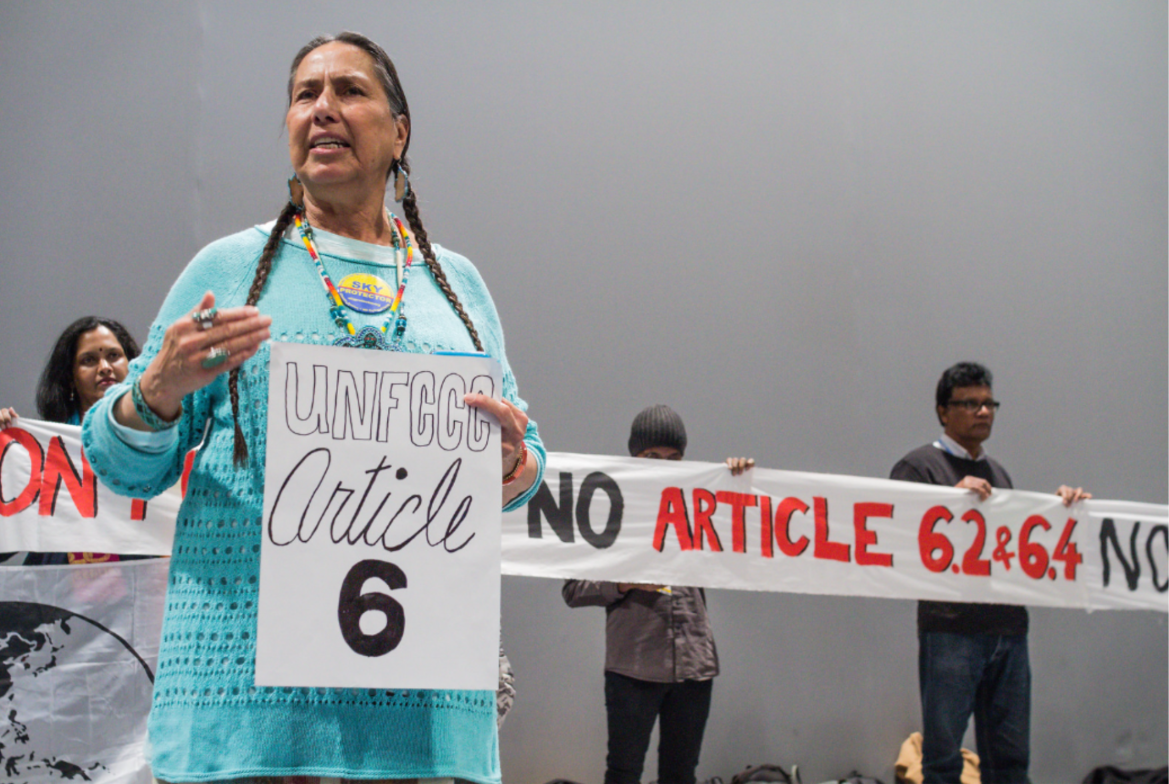
“no carbon markets” by Friends of the Earth International via Flickr, CC BY-NC-ND 2.0
Right now decisions are being made in the Voluntary Carbon Market (VCM) that will set the stage for how the industry operates for years to come. The UNIDROIT Principles on the Legal Nature of Verified Carbon Credits aims to codify private law guidance on the treatment of verified carbon credits (VCCs) and reduce legal uncertainty. As an intangible thing, the very definition of what a carbon credit is has been subject to debate and scrutiny for some time. UNIDROIT’s draft Principles largely follow the recommendation from various actors involved in these debates that credits should be treated as an intangible property right. They do so, however, by relegating questions surrounding who holds rights to the land or forest behind a credit to “other law” outside the scope of these Principles. While UNIDROIT argues this is necessary to present a set of narrow and actionable Principles that can be integrated into diverse domestic contexts, various commentators have warned about the potential for abuse in the VCM that can follow from detaching the right to claim a reduction from the underlying land and livelihoods that create that reduction. Without community consent, the facilitation of carbon trading can result in making land grabs easier in a market with a record of community-rights controversies. This is germane to UNIDROIT’s Principles in that the underlying rights, obligations, and overall legal basis for carbon credit generation is an unsettled issue, and the different layers of rights and laws at the project-level that structure the creation of VCCs fall, in some instances, directly within the already narrowly defined scope of these Principles.
While many who are not direct market participants are unaware, these draft Principles could contribute to a quiet rewriting of the rules governing the VCM at a time when carbon offsets are receiving renewed interest. Depending on how the Principles are finalized, the positions taken in them could, for example, help the industry deliver climate mitigation outcomes while respecting the rights of Indigenous Peoples and local communities. Or, to the contrary, the Principles could run the risk of entrenching land grabs that do little for the climate and lead to further exploitation of communities. The stakes are high, the details matter, and this is why SDSG submitted comments on the draft Principles to make sure UNIDROIT takes into account the rights of Indigenous Peoples and local communities.
The International Institute for the Unification of Private Law (UNIDROIT) is an independent intergovernmental organization with the express purpose of modernizing, harmonizing, and coordinating private commercial law between states. The organization does this in part through the formulation of principles and rules, as they are undertaking now in an attempt to unify how different jurisdictions regulate aspects of the VCM. Between 13 July and 21 September 2026, UNIDROIT solicited public comments on its draft Principles on the Legal Nature of Verified Carbon Credits. We will dig into the weeds and details below, but our overall remark is that UNIDROIT limited the scope of the Principles to a narrow and “specific subset of private law issues” about the creation, trade and retirement of carbon credits while completely ignoring critical legal issues plaguing the integrity of the market. These include questions about the interface between land/resource ownership of carbon stocking natural assets like forests and peatlands, what types of consultation and consent should be obtained by project developers, and how illegalities should be dealt with in the market ripe with fraud and abuse.
SDSG has long held the position, alongside others, that ownership of carbon “assets” derived from nature should be vested in the legitimate land/forest tenure owners–even if their tenure rights are not formally registered–per the guidance contained in the FAO’s Voluntary Guidelines on the Responsible Governance of Tenure (VGGTs). The market consensus has historically been that carbon credits come into existence once issued on a registry, giving rise to the working assumption that carbon project developers or proponents that hold registry accounts assume ownership of the assets.
Verra’s recent update to their Verified Carbon Standard (VCS 5.0) has recognized the flaws in this assumption and attempted to respond to it by separating a project’s right to operate on the one hand and the right to ownership of carbon credits on the other (VCS 5.0 Section 3.6). Project proponents must now report on how they have obtained these rights separately, and must assess existing customary rights in the project area “regardless of whether the claims are recognized or fully formalized under the national legal framework” (VCS 5.0 Program Definitions, pgs. 14, 24). We have commended these changes in the past as major steps forward, at least on paper, by the VCM’s biggest certifier. We, however, maintain our belief that carbon ownership should be explicitly linked to the tenure of the underlying carbon-stocking asset. This is not a position commonly held across voluntary market participants, nor generally supported by government regulatory frameworks, though there are some domestic legal contexts–Brazil for example–where national law on carbon markets explicitly affords carbon rights to communities holding natural assets under collective customary tenure arrangements.
The Unsettled Nature of How Carbon Credits Are Generated and Who Owns Them In Domestic Law
Across many jurisdictions, what a carbon credit is, what rights affect the generation and distribution of benefits from the creation of a carbon credit, and how this interacts with existing laws, is not a settled issue. Kenya has one of the most comprehensive and celebrated carbon legal frameworks of any “host” country. Nevertheless, its carbon regulations do not support a clear approach to what exactly a carbon credit is and how the government, or investors, ought to treat these units. Under the Community Land Act, 2016, community land in Kenya has equal force in the law as freehold and leasehold rights (Section 5(3)) and, reflecting this status, communities with tenure rights have a right to a “free, open consultative process” with third party investors seeking to invest on community land (Section 36(1)); any resulting agreement will “only be made between the investor and the community” (Section 36(2)). However, The Climate Change (Carbon Markets) Regulations of 2024, through their application of the CDA model of community benefit-sharing and their treatment of projects on community land as equivalent to projects on public land (Section 16) fulfills the government’s approach to VCCs as a public good which it has the ability to transfer to private interests and from which it can determine the flow of benefits. In short, the results of a GHG mitigation activity appear to flow to tenure rights holders in Kenya, however the government’s designation of these units as a public interest has served as cover to intervene in benefit-sharing negotiations and transfer ownership to project developers, potentially violating property protections under the 2010 Kenyan Constitution (Section 40).
In both the Democratic Republic of the Congo (DRC) and Indonesia, carbon rights are vested in the state, but the legal nature of these units and how they come into being are entirely unclear, even under recently passed legislation. In DRC, carbon is not considered a forest product, meaning established rights and obligations for forest products are not applicable, and carbon rights have generally arisen and been transferred by the state to private developers under varied conditions on case-by-case bases. The recent Ordinance-Law No. 26/016 on Carbon Markets (Loi Carbone) applies a suite of new safeguards and benefit-sharing requirements, but it remains to be seen how these will be enforced and the new law does not fundamentally change or address the nature of carbon rights or carbon credits in the DRC. Conversely, carbon units are treated similarly to forest products in Indonesia where carbon rights are established not on the basis of tenure, but on the basis of various kinds of forest utilization permits. There are provisions for communities holding certain social forestry licenses to organize their own carbon projects, but the commercialization of these units must still involve third parties with existing experience and involvement in carbon markets.
Ethiopia and Brazil, on the other hand, vest ownership of carbon units in holders of the land where the credits are produced, though in different ways. Article 7(1) of Ethiopia’s Forest Carbon Trading (Amendment) Directive No. 1141/2026 expressly provides that “forest owners” hold ownership rights and legal title to forest carbon credits generated from projects undertaken in or on their forests and Article 7(2) further permits such owners to transfer their ownership rights to any third party. The Directive does not, however, define “forest owner” or expressly clarify whether the term encompasses customary or communal land-rights holders. This is relevant in light of the Humbo Community-Managed Natural Regeneration Project, where, in the absence of specific rules governing ownership of sequestered carbon, a project-specific legal opinion concluded that communities holding rights to communal land owned the carbon generated through their reforestation activities.
A further issue concerns the transfer of ownership, the detail of benefit-sharing requirements, and the scope of FPIC protections. Although Article 7(2) permits forest carbon credit owners to transfer their ownership rights to any third party, the Directive does not expressly establish specific safeguards governing such transfers, including where the original owners are communities or other potentially vulnerable rights holders, or in relation to the appointment of a legally authorized person to implement the forest carbon project under Article 15(2) when the ‘forest owner’ is unable to do so. Moreover, while Article 7(7) provides for benefit-sharing, it does not, on its face, restrict the transfer of ownership or establish specific safeguards concerning bargaining power or contractual terms, including mandatory FPIC requirements or minimum statutory thresholds for benefit-sharing percentages.
Under Brazil’s Law no. 15.042 of 11 December 2024 (hereafter ‘Brazil’s Law no. 15.042’), original title to carbon credits are vested in the generator of the carbon credit (Article 43). Brazilian legislation establishes a number of distinct legal scenarios for determining who is deemed to be the “original titleholder”, depending on the specific legal context, including whether the carbon credits are generated by jurisdictional programs, on unappropriated public lands, private property, or other types of land. In this regard, Brazil’s Law No. 15,042 unequivocally establishes that original title to carbon credits generated on lands traditionally occupied by Indigenous, traditional, and Quilombola communities rests with these communities (Article 43, paras. V–VII). Moreover, under Article 47, Indigenous, traditional, and Quilombola communities, through their representative organizations and within their respective territories, have the right to commercialize carbon credits generated through projects in the territories they traditionally occupy.
In other words, Brazil offers a rare example where Indigenous Peoples do hold rights to carbon when projects are undertaken on their land, while Ethiopia also approaches carbon credit generation in a way that potentially permits this approach. The legal nature of carbon units, what rights and obligations define the projects that generate them, who has a legitimate claim to ownership of and/or benefit from carbon credits that arise from a given project are legal issues with wide ranging approaches that carry different implications for land tenure and ownership. Despite UNIDROIT excluding these issues from its draft Principles, we maintain that these legal issues are highly relevant to the creation and validity of the resulting VCCs. When UNIDROIT limits its Principles to a "specific subset of private law issues,” leaving everything else to "other law", the Principles miss this reality and undermine their own goal of bringing clarity and uniformity to the market. The UN has flagged unresolved questions over carbon ownership as a regulatory gap in developing countries, and with the market expected to quadruple within seven years, UNIDROIT should address this now.
SDSG’s Recommendations and Comments on UNIDROIT’s draft Principles
Given the above considerations, SDSG submitted extensive comments to UNIDROIT regarding its draft Principles on the Legal Nature of Verified Carbon Credits. The major themes SDSG focused on include the following:
SDSG argues that, as a matter of policy, these Principles must recognize, at minimum, that the creation, validity, and legality of VCCs may depend upon the existence and exercise of underlying proprietary, community, and other legally recognized rights. Where carbon projects are developed on land or in relation to natural assets subject to community rights, those rights may determine ownership of carbon credits and there likely exist additional procedural requirements that need to be met before the valid creation of VCCs.
In response to paragraphs 37-38 in the draft Principles, which recognize the environmental and social safeguards established by Certification Bodies to which carbon projects must adhere: we recommend that the Principles expressly recognize the role of host State law and refer to relevant international soft law instruments such as the VGGTs. In land-based carbon projects, host State law may establish who holds the original title to credits generated in the territories of Indigenous Peoples and other rights-holders, set benefit-sharing requirements, and require free, prior and informed consent (FPIC), as provided for in ILO Convention No. 169 and the UN Declaration on the Rights of Indigenous Peoples (UNDRIP). Because community ownership of carbon credits remains unsettled in many jurisdictions, with direct consequences for how credits are created and who owns them, the VGGTs should apply even where customary tenure is unsettled in domestic law. Otherwise, carbon markets risk becoming a tool for dispossessing legitimate rights-holders instead of recognizing and securing their rights.
In response to Principle 5, which provides that a VCC comes into existence when it is recorded in a VCC registry, and that the registered holder, or its client, has a proprietary right at that moment: in effect, this affirms the “carbon grabbing” theory; the assumption/presumption that project developers and their financiers own carbon credits as long as they can get them on some sort of registry, even in cases where they violate community rights, FPIC requirements and benefit-sharing obligations. Treating creation as separate from those rights is the artificial legal separation we warned the drafters against. Principle 5 should provide that the proprietary right to carbon credits arises only where the VCC was created in line with applicable domestic and international law, including host State law, and that registration of credits neither cures non-compliance nor extinguishes the rights of Indigenous Peoples and other rights-holders simply because they are not the first registered holder.
In response to Principle 10(3), which establishes the grounds for revocation of a VCC: bearing the above in mind, we recommend that the Principles should allow a carbon credit to be revoked (that is, cancelled or removed from the carbon market), where a project has harmed the rights or interests of communities or groups, including customary rights holders and Indigenous Peoples, and/or when a government agency, competent court or other judicial authority later finds that the project violated the host country’s laws protecting those rights. This could apply, for example, where a project failed to comply with laws relating to original title to carbon credits, land rights, FPIC, or legally required benefit-sharing. Compliance with these laws should be part of what makes the creation or issuance of a carbon credit lawful in the first place.
In response to Principle 13 which establishes that the effect of illegality on a VCC is a matter for other law, and Commentaries 13.1, 13.2, and 13.4 which explain other law further and address illegality under the law of a host state: the Principles’ current approach to illegality privileges the law governing the carbon credit itself (the lex registri, that is to say the law of the place where the registry is located), without sufficiently addressing the laws of the Host State; the country where the project takes place. We recommend that UNIDROIT strengthen this Principle so that serious violations of relevant host State law or international law are not treated as having no bearing on the carbon credit’s creation. The Principles should also make clear that these issues must be considered as part of the verification process. This would help address wider concerns about conflicts of interest in the carbon market and ensure that projects are properly scrutinized before credits enter the market, so registration does not erase compliance.