
Sharing Benefits in the Carbon Market: SDSG’s New Carbon Hub Seeks to Address Limitations and Highlight Best Practices
/By Matthew Schwarzenbach and Bennett Jarvis
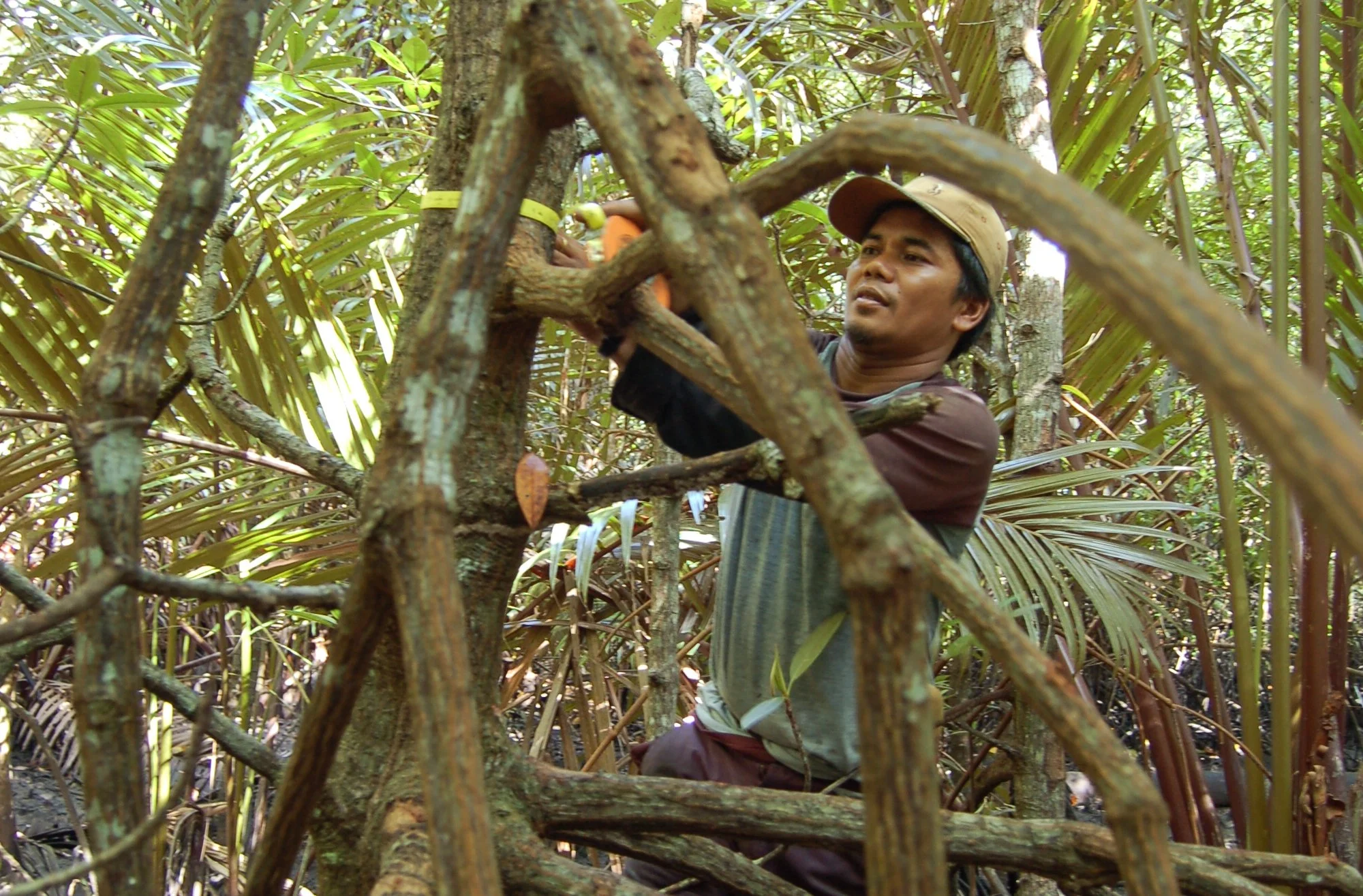
Estimating carbon stock from Flickr by Landscape Alliance, CC BY-NC-ND 2.0
Introduction
Benefit sharing and benefit-sharing agreements (BSAs) are common instruments used in mining, infrastructure, and other land- and resource-intensive projects to formally establish and mediate the distribution of benefits from a project to local stakeholders, often communities living in and around project areas. Arrangements and mechanisms for benefit-sharing in nature-based carbon projects–projects that alter land-use in forests, peatlands, rangelands, and other biomes to sequester carbon and generate tradeable units (carbon credits)--are still in relative infancy, though standards and toolkits for “high-integrity” projects and benefit-sharing mechanisms are slowly beginning to emerge.
As nature-based carbon projects have risen in prominence as a climate mitigation tool, questions of who owns the carbon units, who is entitled to the benefits from their creation, and how to mediate these claims, has become a crucial issue. In response to reports of abuse and rights violations against local communities and Indigenous Peoples living in and around project areas, the standard-setters in the Voluntary Carbon Market (VCM), the “Certification Bodies”, alongside a suite of “integrity”-focused initiatives have established new working standards to ensure more accurate carbon accounting for projects and address risks to local communities, including by instituting guardrails for benefit-sharing. In some cases, national legal frameworks have also implemented benefit-sharing requirements.
These are, at least on paper, steps in the right direction. SDSG’s recent research and advocacy, which has focused on understanding and improving benefit-sharing requirements and practices across the VCM and UN-sanctioned Article 6 pipelines, points to uneven and often inadequate standards for governing what types of benefits will be generated for local communities and Indigenous Peoples and how the agreements will be implemented. Without adequate safeguards, opaque accounting practices by project developers, delays in project profitability, and changes in land access or restrictions on land-use, all common problems in nature-based carbon projects, threaten the ability for communities to see real benefits even when formal agreements exist.
In response to these circumstances, SDSG is excited to launch our new Carbon Hub, an online resource that provides access to introductory information and coverage on carbon markets targeting Indigenous Peoples and local communities. The Hub also offers overviews of regulatory regimes across different countries, resources to support communities and their supporters when entering project implementation and benefit-sharing negotiations with project developers, and will soon provide more detailed assessments of benefit-sharing frameworks based on our reviews of regulatory frameworks and assessment of over 100 projects’ public-facing and reported benefit-sharing approaches. The following provides some initial findings.
The Current State of Benefit-Sharing in the VCM
At present, many projects treat carbon BSAs like box-ticking exercises to be completed in order to receive validation from the few Certification Bodies that require it. Instead of forming integral aspects of project developers’ operations throughout the project lifecycle, they are often referenced in vague terms in project design documents, at times as a future prospect rather than a comprehensive process that informs project design and budgeting. Many public-facing project approval documents will vaguely reference benefit-sharing arrangements as “in development” or as “future agreements.”
In Indonesia a set of projects in the Verra Registry received public complaints that the lack of existing consultation and benefit-sharing documentation not only contradicts Verra’s own standards, but also violates Indonesian law which, however imperfectly, requires FPIC and benefit-sharing documentation to be included in the project design document (MoF 6/2026, Article 12). Other recently updated legal frameworks such as those in the Democratic Republic of the Congo (DRC) and Kenya have also established clearer benefit-sharing regulations, as has Verra with the launch of its Verified Carbon Standard (VCS) 5.0 in December 2025. Unclear implementation requirements, low (or in some cases non-existent) baseline revenue-sharing requirements, a lack of recognition of underlying customary land tenure, and persistent uncertainty surrounding who has rights to the carbon itself have all resulted in limitations to the progress made on paper, but the increasing focus on formal benefit-sharing provisions is notable nonetheless. While each jurisdiction has its own specific problems that we address in our country profiles, some common problems emerge, especially when considering publicly available information on BSAs at the project-level.
Transparency is a major problem across the carbon industry and the lack of transparent benefit-sharing is a glaring area of weakness threatening the viability and integrity of the entire VCM. Of the 126 carbon projects SDSG has assessed over the past year in Kenya, DRC, and Indonesia, none have thus far made their signed BSAs public. If Verra properly enforces the provision under VCS 5.0 that BSAs must be made public unless communities request otherwise, along with the wider project implementation agreement (Section 3.17.17), we should expect this to change in the coming years. Nevertheless, what information we do receive from projects that have already released their Benefit Sharing Plans (ostensibly explaining the contents of agreements, though these are not the signed agreements themselves) or which include information about benefit-sharing in project documents, is uneven.
Some projects provide extensive information on ambitious community-focused programs, detail how these programs were determined in consultation with communities during project development, and establish plans for how these benefits will be maintained even after the project has ceased to generate credits. Other projects entirely sidestep explaining benefit-sharing mechanisms or make vague claims about sharing revenues or paying communities. In any case, without publicly disclosed agreements or strong, independent assessments, it can be difficult to tell whether these claims extend beyond the documents in registries. For instance, in some cases we assessed, projects with relatively comprehensive benefit-sharing descriptions were also the subject of reporting or public comments that indicated communities did not see the project as particularly beneficial to them or that project claims were dubious.
The Rimba Raya Biodiversity Reserve is an illustrative case. The Rimba Raya project is a major REDD+ project in the VCM that has been widely viewed as a best-practice example for other nature-based carbon projects. The project made headlines in 2024 when the Indonesian government revoked the project’s license, only to reinstate its license months later. That same year, Austrian television program ORF released a documentary investigating greenwashing where the Rimba Raya project was one of the focal points. Locals interviewed in the documentary expressed ambivalence about the project, claiming that, despite the project’s promises, little had changed except they could not enter the forest to contain fires. There are many other examples as well of community outcries and independent reporting revealing abuses, rights violations, and misrepresentation of project activities that are papered over by documents submitted to registries.
Another major issue is determining what actually counts as a benefit versus what is a project cost. This is important as, in many projects, seedlings to farmers, expertise and trainings for how to participate in the project, and project employment are listed as project benefits for the wider community, essentially claiming costs for undertaking the project as shared benefits. National frameworks generally do not provide guidance on what does and does not constitute a benefit. Verra’s VCS 5.0 does establish a list of things that cannot constitute benefits such as goods associated with implementing project activities, infrastructure necessary for the project, mitigation measures for safeguards, and project workers' salaries (Section 3.17.15). Though a community may have consented to participate in a project in exchange for specific benefits, without transparent evidence of FPIC processes or mandated legal support for communities, there are real risks communities ‘negotiated’ agreements with project developers from an unfavorable position.
When it comes to revenue-sharing, carbon projects rarely disclose the amount of revenue they share with communities or on what basis this revenue is calculated. Verra’s Standard, along with many national jurisdictions, does not provide clear guidance for this and countries that have established rules, like Kenya and the DRC, only require sharing based on net-revenue or, in other words, profit-based sharing. The idea is that revenue is only shared with communities once the costs of the project have been deducted. Nature-based carbon projects typically have highly uneven revenue streams over the years, peaking around years 5-15 for nature-based removal projects while decreasing or plateauing thereafter. Nature-based removal projects can also be capital-intensive and take between 8-15 years to break even. Even the less capital intensive and more financially stable avoidance projects can take 3-7 years to break even and typically credits from these projects fetch much lower prices. In other words, community benefits may not materialize for years (in some cases upwards of a decade), if at all. Yet, the multi-decade agreements communities sign with carbon developers can entail drastic changes in land-use practices that reduce access to livelihood activities and hurt household income. Over the past few years there have been multiple high-profile scandals and community upheavals caused by carbon projects that failed to deliver benefits while communities were resettled or restricted from previous activities that were integral to their livelihoods.
Changes to livelihoods can be quite disruptive, at times in ways that are not captured in standard economic data. Less visible elements of livelihoods such as wood gathering, foraging, and other ‘informal’ activities, often carried out by women, can be disrupted by carbon projects if they are not factored into project development agreements. Indeed, without strong FPIC practices, these factors can be left out of agreements, a problem that extends well beyond carbon. In these cases, cash transfers may not be able to fully compensate for lost livelihood activities, even if designed well. Furthermore, if a project is paying communities, once it ceases to do so, what environmental or development gains were achieved can fade quickly if benefits are not directed towards lasting community development, again raising questions about the long term efficacy of these emissions reductions investments. There are numerous projects that claim to contribute benefits like social infrastructure, schools, livelihood planning, etc., but without increased transparency these benefits may be little more than words on paper.
Lastly, there are the underlying problems of insecure land tenure rights and unclear rights to the carbon units. VCS 5.0 made some progress addressing the issue of carbon rights and the legal nature of carbon units is currently a topic of serious debate in the VCM. We discuss these issues in greater detail in our recent blog on UNIDROIT’s Draft Principles on the Legal Nature of Verified Carbon Credits. It suffices to say here that few countries have clarified carbon rights–Indonesia and the DRC both vest carbon rights in the State and Kenya has not directly addressed it though the State has treated carbon as a public good. Whether these units are “forest products” is also unclear and handled differently across different jurisdictions. The result has often been that rights are transferred to companies by the state with little or no input from communities in the project area. Communities in these circumstances find themselves as passive beneficiaries with no legal claims beyond minimum benefit-sharing requirements rather than as active stakeholders with enforceable claims over the project.
The overall picture that emerges is a fragmented set of benefit-sharing requirements across different laws and standards that are insufficient to provide meaningful benefits to communities in most cases. There are also limitations within carbon markets that have proven to be barriers to improvement. This includes the fact that carbon project developers often work on tight margins, especially since nature-based carbon credits from jurisdictions in the Global South tend to fetch low prices on the VCM. While we do not see this as an excuse for weak benefit-sharing and community consultation practices, this is an undeniable limitation, and one which reinforces the point that profit-sharing is a dubious approach to supporting sustainable development in project-affected communities. In practice, this limitation also raises questions about the viability of projects that make extensive claims to be funded by revenue from carbon credit sales.
Recommendations and SDSG’s Efforts
SDSG is not a proponent of carbon markets as a climate mitigation tool. We instead favor alternatives such as carbon taxes, fulfilling G7 climate pledges, improvements to public forest finance, and non-market arrangements such as those provided for under Article 6.8 of the Paris Agreement. But we do recognize the growing prominence of carbon markets in national and international climate strategies, most notably demonstrated by recent laws in various jurisdictions seeking to establish clearer frameworks for carbon markets; as such, we see an urgent need to convene strong multi-stakeholder engagement on the issue. This includes engagement across the carbon value chain, ranging from legal support for communities approached by project developers, to conversations with Certification Bodies, the UNFCCC, national governments, and others involved in the architecture of international carbon markets and domestic regulations to improve standards and implementation practices with the goal of supporting real climate mitigation outcomes that do not come at the expense of Indigenous Peoples’ and local communities’ livelihoods and rights.
In pursuit of these ends and based on our research over the past year, SDSG proposes the following recommendations for international standards and national regulatory frameworks:
Require that communities are entitled to independent legal support throughout project negotiations. This is generally not included in standards and regulations, though the DRC’s recent Ordinance-Law No. 26/016 (the “Loi Carbone”) does require that communities receive independent legal and technical assistance (Article 39).
Require the disclosure of signed BSAs and project implementation agreements. VCS 5.0 importantly makes this mandatory for projects registered with Verra, though enforcement will have to be assessed over time. Other registries and national legal frameworks should follow this lead to strengthen this as a regular practice across carbon markets.
Establish clearer baseline standards, requirements, model guides, and implementation procedures for BSAs. VCS 5.0’s establishment of what does not count as a shared benefit and the clear establishment of FPIC as an integral part of project development, benefit-sharing, and regulatory compliance across standards and laws are important steps to build upon. But these requirements remain thin across the board and rarely provide clear model guidelines or implementation procedures.
Vest carbon rights in the holders of underlying land tenure and property rights where projects are located. Again VCS 5.0 has clarified that a right to operate does not automatically include a right to the carbon assets derived from a project (Section 3.6). But the legal nature of carbon credits and the validity of claims to the GHG emissions reductions underlying them remain unclear and rarely do regulatory frameworks explicitly recognize tenure-rights holders as the legitimate holders of carbon rights.
SDSG is proud to launch its Carbon Hub to support these efforts. In the coming months we plan to expand the country profiles to offer more analysis on emerging trends in national legislation. We also plan to engage actively on the development and implementation of international standards and national legal frameworks with a focus on improving benefit-sharing mechanisms. This is an evolving resource open to changes in different countries, project practices, and the structure of the market as a whole–indeed, we are actively advocating for major changes in all these areas.
For more information, to explore our existing resources, or contact us, please visit our Carbon Hub page.